Agentic ISMS: AI agents work inside your ISMS. You decide how far they go.
AI agents derive risks, measures and policies from your documents, fit new frameworks into what you already have and carry out tasks in the system. Every step remains traceable.
60 minutes, live on demo data.
Definition
What is an Agentic ISMS?
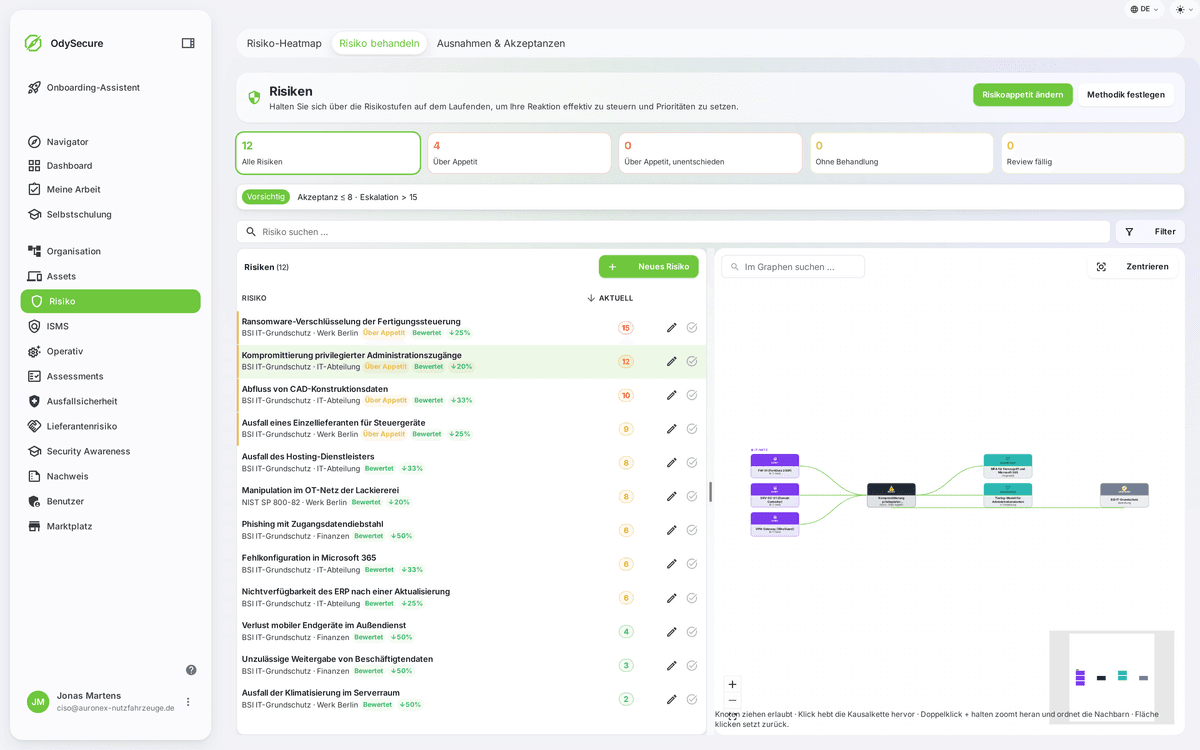
An Agentic ISMS is an information security management system in which AI agents take part in the work: they derive risks, measures, controls and policies from an organisation's own documents, fit new requirements into what already exists and carry out tasks. A person sets how far an agent may act on its own, and every step remains traceable.
ISMS stands for information security management system, as described in ISO 27001.
Three modes
Three ways agents work in an ISMS
The AI in OdySecure works in three modes. The first two are available. Acting through connected agents is in trial with design partners.
- 1
Derive
Available in OdySecure
You upload documents and provide details about your organisation. In six stages, this produces proposals for infrastructure, risks, measures, controls and policies. When a new framework comes in, the AI maps its requirements to what you already have and proposes what is missing. You accept or reject the proposals, one by one or per stage.
- 2
Ask and instruct
Available in OdySecure, as the Navigator
Ask your ISMS. Every answer comes with its source. On your instruction, the Navigator also does work in the system: it links a measure to a risk, creates tasks, records KPI values or schedules a BCM test. Nothing runs until you have confirmed its plan, and it only acts with your permissions.
- 3
Act
Design-partner programme, not yet generally available
Connected agents work under their own identity, with their own role and an autonomy level that you set per task, for example in incident triage. An agent can never close an incident, accept a risk or grant itself permissions.
Ask and instruct
What the Navigator does on your instruction
You write in the chat what needs doing. The Navigator puts forward a plan and carries it out only after you confirm, with your permissions. You can usually undo a confirmed action within the next two hours.
- 1
Instruction
For example: “Create a task to review the password policy.”
- 2
Plan
The Navigator shows which entries it will create or change.
- 3
Confirmation
Only now is it carried out. Anything your role may not do is never offered.
Examples from the twelve actions
- Link a measure to a risk, with the residual risk recalculated
- Assign an asset to a business process
- Change the treatment, rationale or owner of a risk
- Create a task for a policy, a risk or a supplier
- Record a KPI value for a period
- Schedule a BCM test for a contingency plan
- Start a due diligence review for a supplier
- Request a risk acceptance or a time-limited exception. People decide on it.
Which actions it offers depends on your role and the modules you have licensed.
Limits
You decide how far an agent may go
Duties and responsibility for information security remain with your organisation and its management, even when agents take part in the work. For connected agents, you set an autonomy level per task. As soon as an agent carries out work itself, the task needs a person who is accountable for it.
Autonomy levels for connected agents
- A0
Observe
The agent reads and reports.
- A1
Suggest
It makes suggestions, and a person takes them over.
- A2
Prepare
It prepares the work, and a person completes it.
- A3
Reversible action
It carries out changes that can be reversed.
- A4
Action after approval
It carries out work once a person has approved it.
- A5
Prohibited for agents
These actions are reserved for people.
- A6
Autonomous up to the risk threshold
It acts on its own as long as consequences and reach stay below your threshold. Above it, it needs approval.
Connected agents are in trial in the design-partner programme. Levels at which an agent carries out work itself can only be approved by a second person.
What always stays with people
- Proposals from the derivation take effect only once a person accepts them.
- Whatever the Navigator changes, it carries out only after your confirmation.
- Whether a risk is accepted is decided by your organisation, never by an agent.
- A person closes an incident.
- Your administrators grant permissions. An agent cannot grant itself any.
- In a vCISO mandate, a senior CISO from Cybervize leads the implementation and keeps your management informed.
Comparison
Classic ISMS software and an Agentic ISMS
Both run the same management system. What differs is who does the work. The middle column describes the usual shape of ISMS software, not a specific product.
| Question | Classic ISMS software | Agentic ISMS |
|---|---|---|
| Where do risks and measures come from? | From questionnaires and catalogues that someone in-house works through. | The AI derives them from your documents. You accept the proposals one by one or per stage. |
| Where do the policies come from? | From templates you adapt to your organisation. | The AI drafts them from what your documents say. Every draft goes through review and approval. |
| What happens with a new framework? | Another catalogue that someone works through alongside the existing one. | The AI maps its requirements to your existing risks and measures. Where something is missing, it proposes it. |
| How do you answer “Where do we stand?” | With a report or an exported spreadsheet. | Ask your ISMS. Every answer comes with its source. |
| Who does the routine work in the system? | Your team, entry by entry. | Agents, on instruction or as a fixed task in a security process, within the limits you set. |
| Who approves? | Approval workflows for documents; anything else applies once it is saved. | You decide what an agent may do on its own and what needs approval. Proposals remain proposals until someone accepts them. |
| How is the evidence created? | Often as a separate task shortly before the audit. | In day-to-day operation: changes in the audit log, with time, editor and old and new value. |
| What does your security officer work on? | Creating and maintaining entries. | Reviewing and deciding. |
What an ISMS has to achieve is the same in both columns.
Evidence
How you show what happened in the ISMS
For an audit, what counts is who approved what and when. That applies equally to entries made by people and to the work of the AI.
OdySecure logs changes with the time, the editor and the old and new value.
For AI proposals, OdySecure stores the model, the reasoning, their supporting passages in the documents and who reviewed them.
OdySecure logs questions to the Navigator in your organisation's audit log, and its actions together with the person who confirmed them.
The log can only be appended to and is sealed every hour as a hash chain. A verification package lets you recompute the chain outside OdySecure.
Clause 7.5.2 of ISO 27001 requires documented information to be reviewed and approved. In OdySecure, policies go through drafting, review and approval, by default with two different people.
The model behind it
Why agents can work in OdySecure
An agent can only derive what is connected. In OdySecure, business process, asset, risk, measure, control, policy and security process sit in one data model. We call it the ISMS operating system. Through these links, a proposal can be traced back to the requirement it came from.
Getting started
How to get an Agentic ISMS
OdySecure comes in two ways. The AI works the same in both.
In a vCISO mandate
A senior CISO from Cybervize leads the implementation of NIS-2, DORA or ISO 27001 in OdySecure. The mandate starts at €3,600 a month, with the licence included.
As a licence
Your team runs OdySecure itself, with an implementation project if you wish. Prices per tier are on our pricing page.
Frequently asked questions
What is an Agentic ISMS?
How does an Agentic ISMS differ from Agentic GRC?
Can the Navigator also change data?
How does an Agentic ISMS take on a new framework?
Does an Agentic ISMS replace the CISO or the information security officer?
Is an Agentic ISMS compatible with ISO 27001?
What happens if an agent gets it wrong?
Where do the AI models run?
When will connected agents in OdySecure be able to act on their own?
See an Agentic ISMS in the demo
In 60 minutes we show you OdySecure on demo data: how a derivation run works, how the Navigator answers and carries out instructions, and where you approve. If you would rather talk about a vCISO mandate first, book an intro call.