01
Which decision can I make better afterwards?
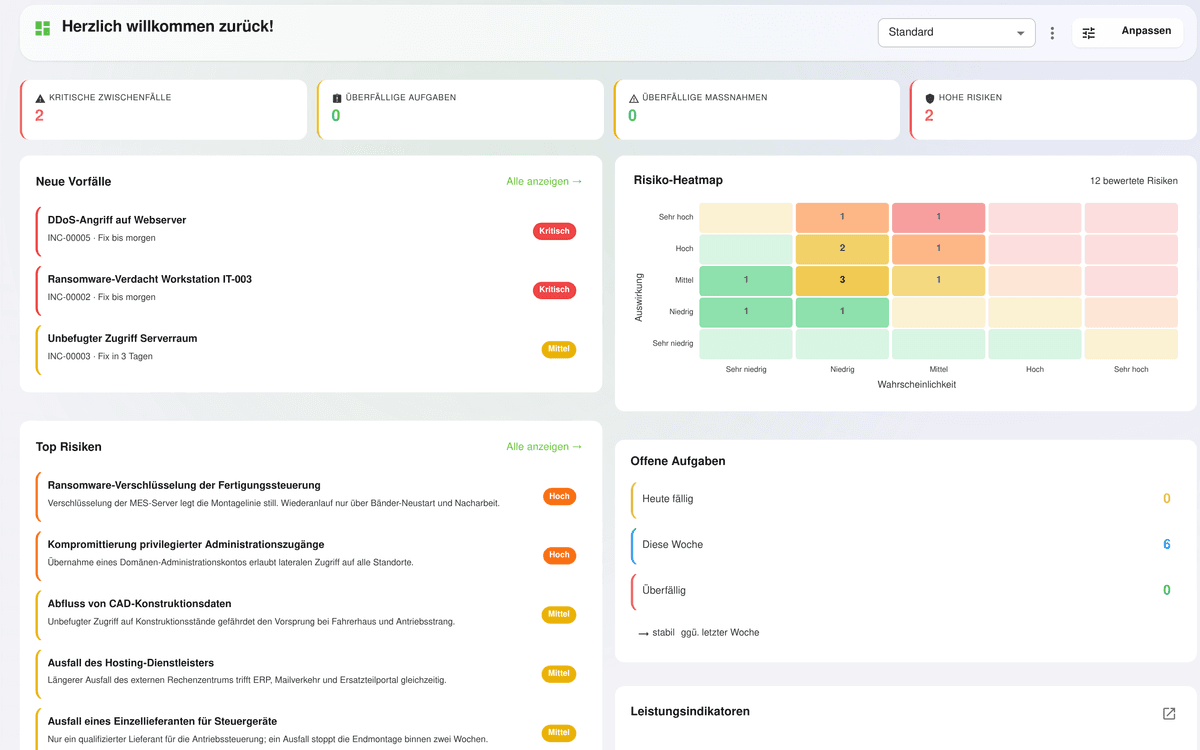
Investment prioritisation based on quantified risks. Top-10 risks with mitigation status and budget annotation, sorted by business impact. Which order you work through them in is your call.

 OdySecure, the security platform by Cybervize
The security platform by Cybervize grows with you, from an owner-led mid-market company to a corporate group. Five modules share the same data layer, permission model and audit trail: one continuous information flow instead of silos.
What the AI takes over
OdySecure derives what applies in your organisation: from your documents and your structure, from business process to security process, each station a proposal a human accepts.
Your documents are read and broken down into checkable statements. From them come the business processes that need protecting.
Sites, systems and dependencies are recognised as an organisation graph and linked to the processes.
Risks emerge from assets and obligations, not from a template.
For every risk, the measures that make it smaller.
Measures are mapped onto the controls of your frameworks, several at once.
The result is a proposed policy, derived from your organisation rather than a template. It becomes a binding policy only after your sign-off.
Policy and measures move into day-to-day operations: tasks with a due date and an owner, with evidence produced as the work is done.
Every station produces proposals, not facts. You accept them one by one or per station, you pause the run, resume it or undo it. Policies carry an approval record naming who signed off. Guardrails and segregation of duties apply to the AI exactly as they do to your staff.
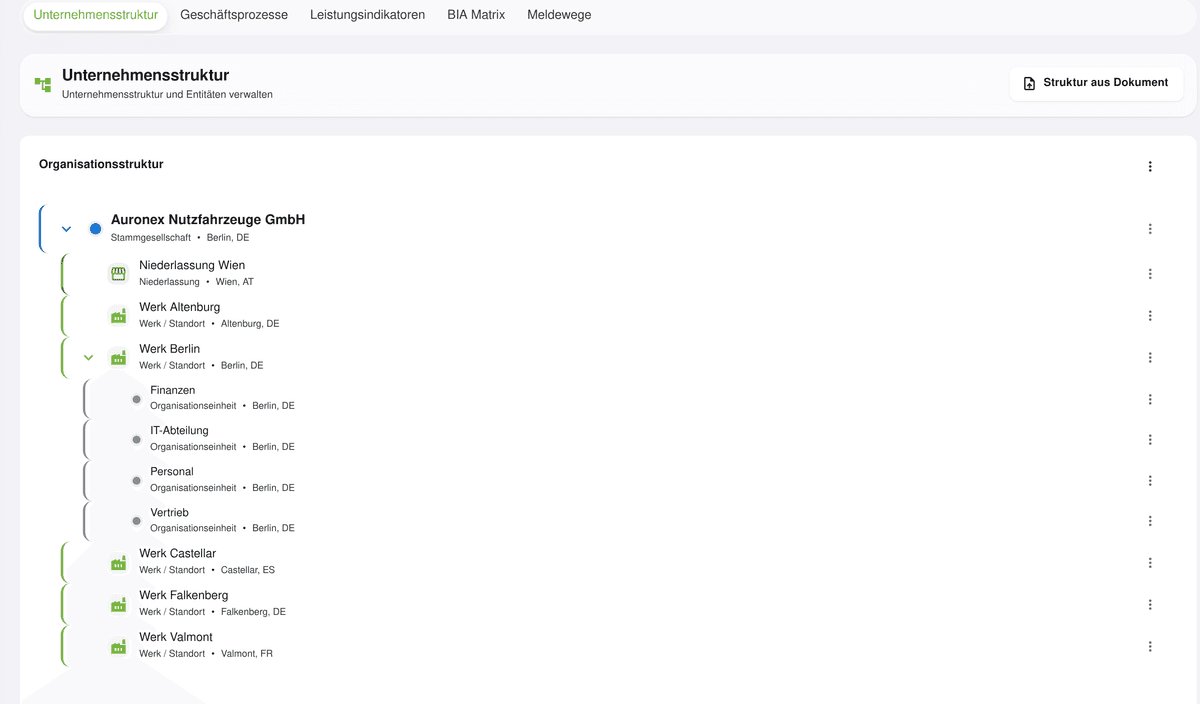
Parent company, plants across several countries, a branch office and the organisational units beneath. Every level carries its own assets, risks and evidence. From the software, not a mock-up.
Information security management per ISO 27001. Organizational structure, BIA, incident management with regulatory reporting (GDPR 72h, NIS-2, KRITIS), asset inventory with dependency graph, dual risk assessment, measure tracking, controls and Statement of Applicability.
More about the ISMS module →Questionnaire-based security assessments against any standard. OSCAL import (BSI Grundschutz, NIST SP 800-53, IEC 62443) or your own standards created directly in the platform, multi-site campaigns, automated scoring, audit-proof snapshots and automated reports with built-in LLMs (PDF, Excel, PowerPoint).
More about the Assessment module →Business Continuity Management per ISO 22301. Continuity plans with RTO validation against BIA data, threat scenarios, gap analysis, BCM tests (tabletop to full exercise), compliance score and management reviews with auto-populated KPIs.
More about the BCM module →Third-party risk management for suppliers and service providers. Automated criticality assessment, contract register with 19 EBA mandatory fields, subcontractor chains, due diligence, concentration risk, exit strategies and cross-app impact analysis. Contract register and exit strategies follow financial regulation: DORA has applied since 17 January 2025, and the EBA consultation paper CP/2025/12 is a draft that builds on it. Criticality assessment holds outside financial supervision as well, because ISO 22301 treats suppliers and partners as a dependency of time-critical activities and includes them in continuity solutions.
More about the TPRM module →Security awareness with audit evidence. Workforce register from a file import, previewed before it is written, training in five languages with company-specific tailoring and review before release, phishing simulation measured by report rate with immediate follow-up training, policy acknowledgement and evidence export for ISO 27001 A.6.3 and NIS-2 Article 20.
More about the awareness module →No silos. Defined interfaces between all modules.
Gaps become measures with one click
BIA data validates BCM plans. Test failures create measures
Supplier risks linked to assets and incidents
Critical suppliers create threat scenarios
Platform foundation across modules
Strict data isolation. Consultants work across tenants without mixing data.
Module license, roles, attributes and entity scoping. 16 predefined roles. Default-deny.
Segregation of duties for approvals, snapshots, risk acceptances and measure completion.
Actions are logged: who, when, what, from which IP. CSV export for auditors.
60 minutes, live on demo data.
From the trigger to a passed audit: the Cybervize journey has five stations, and you join wherever you stand. With or without an in-house CISO.
Without an in-house CISO, we fill the function in the vCISO mandate, with OdySecure included. About the vCISO mandate
What happens in which order, and who does it
How long it takes depends on your scope, and we will not quote a number of weeks we cannot evidence. What you can know beforehand: the maturity check gives you a first traffic light in five minutes, without signing up.
The AI that names its sources and says no when data or read permission is missing. Questions are logged for audit.
The AI layer is not a fifth module. It uses the same platform core as your people: role model, four-layer RBAC, four-eyes rules and audit trail apply to AI agents unchanged. That is why the OdySecure Navigator can answer from connected data, and why agents only act within the same boundaries that apply to humans.
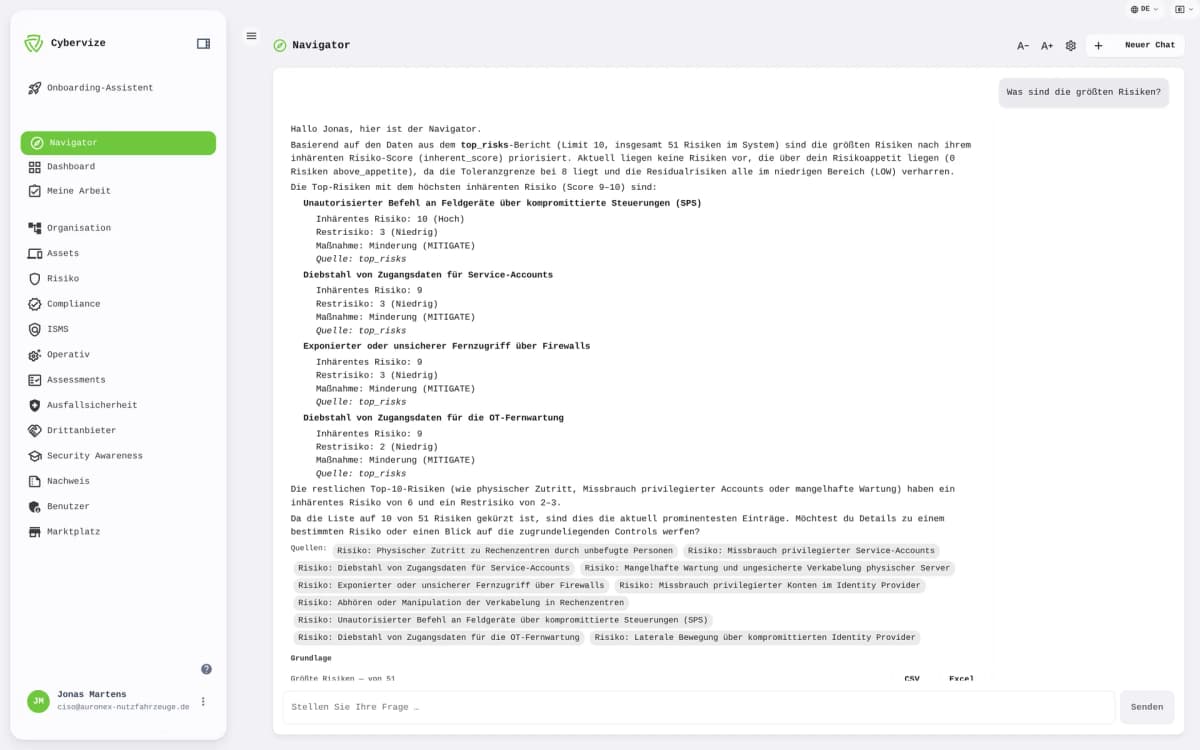
The assistant answers questions like "What are our biggest risks?" or "Are we audit-ready?" from your tenant's real data: around 25 vetted queries, every answer with source and metric, strictly within read permissions. If there is no data or no read permission, it says exactly that.
AI as an employee: its own account, roles, a visible AI-agent badge. Suggesting is the default; acting is limited to narrowly defined fields and requires four-eyes approval. In a design-partner programme, not yet generally available.
A general-purpose chatbot with document upload answers from whatever it is given: no read permissions, no current numbers, no log. An AI checkbox next to a GRC form does not turn questionnaires into connected data. The OdySecure Navigator answers from your tenant's connected, current data: with source and metric, strictly within read permissions, logged for audit, in the default mode on a model operated locally in Germany. When it cannot answer, it says so: "no data" is a different answer than "no read permission". Our vCISO works on the same live records within the mandate.
60 minutes, live on demo data.
From business process through asset, risk, measure, control and policy to the security process, every element is linked. Evidence is produced in daily operations, and every causal chain can be traced back to the requirement.
The reporting procedure for a data breach, as a workflow inside the software: four steps, each with what to do, including the 72-hour deadline from Article 33 GDPR. Not a mock-up.
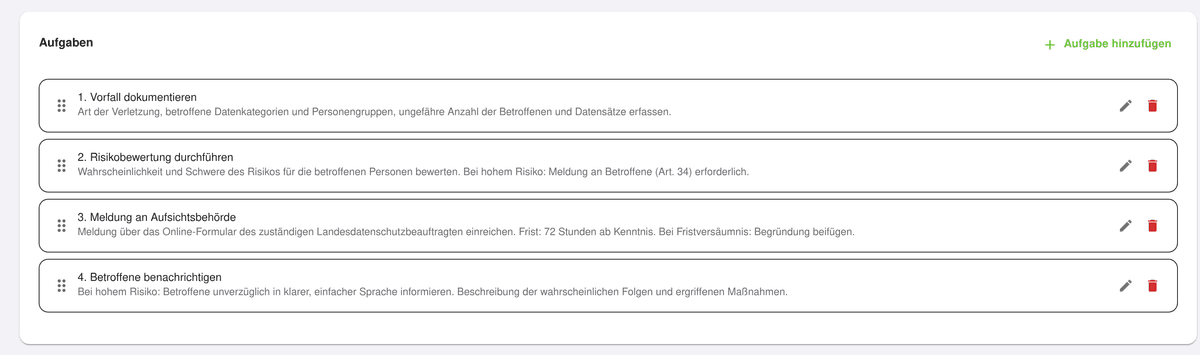
Anyone evaluating an ISMS tool typically compares three categories: stand-alone ISMS software (ISO 27001 only), Excel/SharePoint home-grown setups, and large GRC suites. OdySecure is none of these. Here are the four dimensions where it differs measurably.
Conventionally, ISMS sits in one tool, BCM in a second, TPRM in a third and assessments in Excel or a fourth tool. Four data models, four permission models, four audit trails. Data is synchronised manually or not at all.
ISMS, BCM, TPRM and Assessment share one data layer. From assessment gaps you create measures with one click, BIA data validates BCM plans, critical suppliers in TPRM create BCM threat scenarios. One audit trail, one permission model, one reporting view.
When a new standard such as DIN SPEC 27076 appears, classic ISMS tools take months until the vendor adds the catalogue. Excel in the meantime.
OSCAL import (NIST's official format for security catalogues) lets new standards be loaded in minutes. BSI IT-Grundschutz, NIST SP 800-53, IEC 62443, DIN SPEC 27076 are already in. Own sector catalogues likewise.
Where the vendor sets the AI path, you do not get to decide where the data goes.
Three operating modes: Sovereign (self-operated LLMs in Germany, no external data sharing), BYOK (customer brings their own OpenAI/Anthropic/Azure keys under their own contract) or Managed. Three modes, three data-flow logics, configurable per tenant.
Classic ISMS tools are software products whose vendors buy in regulatory depth or licence it from consultants.
The platform codifies the methodology of our vCISO mandates. Built in a 14-month partnership with the CISPA incubator (Helmholtz Center for Information Security), funded by the German BMFTR StartupSecure programme. In a vCISO mandate our vCISO works with it.
This section compares typical tool architecture patterns, not named vendors. For a vendor-specific comparison against your current tool, book a 30-minute call.
Still working out which route is right for you? The four ways to ISO 27001, compared
Because classic GRC tools turn compliance into a tick-box exercise, instead of anchoring it in day-to-day operations.
Cybervize was founded in 2021 on one thesis: information security consulting delivers the greatest value when the right platform comes with it. The goal from day one was to implement information security so that it stays provable in day-to-day operations.
Classic GRC tools mostly just ask questions that someone in IT has to answer. Compliance becomes a tick-box exercise running parallel to day-to-day operations, never anchored economically in the operational business. OdySecure was built to remove exactly this split: compliance requirements are woven into the running security and IT processes, evidence is generated within day-to-day operations, and operational processes are compliant by default. Development was funded by the German federal government's StartupSecure programme and took place in a 14-month partnership with the CISPA incubator, the Helmholtz Center for Information Security.
Today, Cybervize comprises two independent companies: Cybervize Consulting GmbH delivers vCISO and Interim CISO engagements, while Cybervize Operations GmbH licenses the platform to mid-market and enterprise clients. The consulting practice came first; the platform is its tool and the second route: in the vCISO mandate our vCISO works with OdySecure, and organisations with their own CISO license the platform on its own.
The name OdySecure comes from a federally funded research project: "Effective management of cyber security in SMEs through automation", funded under the StartUpSecure programme of the German Federal Ministry of Research, Technology and Space. The software licensed today grew out of that project.
A standard you choose, a regulatory requirement applies to you. The platform keeps both as a catalogue: 50 frameworks, ISO 27001 as the shared language.
ISO 27001 is the platform's common language. Further standards are mapped onto it via crosswalks wherever their requirements can be meaningfully aligned: a control implemented once then serves several frameworks at the same time and reduces duplicate upkeep. Obligations that cannot be expressed as a control are managed in their own right. Each activated standard gets its own statement of applicability and maturity view, either as a certification goal or as a reference mapping. New standards are added as data, not as custom development: load the catalogue, maintain the mapping, activate.
Why does this measure exist, and which standards does it cover?
Does the measure actually work, and how does it change the risk?
Both chains share the same objects on the platform, and the effectiveness loop is a control loop: evidence, tests and telemetry change the effectiveness assessment and with it the residual risk, and the residual risk triggers new measures where needed. If a piece of evidence lapses, it is visible which requirements and which risks depend on it.
curated mappings connect ISO 27001, NIS-2 and BSI IT-Grundschutz in the core crosswalk. Every single one has been reviewed by a security expert and typed as equivalent, partially covering, or related. AI suggestions stay marked as suggestions until a security expert has reviewed them.
Five management questions every board should have ready for the supervisory board, the external auditor and the insurer. The platform delivers them on demand, not as an IT translation exercise.
Investment prioritisation based on quantified risks. Top-10 risks with mitigation status and budget annotation, sorted by business impact. Which order you work through them in is your call.
On-demand reports with audit trail, ISO 27001/NIS-2 status, sector-specific evidence (DORA, IEC 62443, TISAX). Exportable as PDF, Excel and PowerPoint. Every statement is documented with timestamp, owner and source.
Risk register with status, owner, due date and 12-month trend. Accepted risks have documented reasoning, open risks have owners and deadlines, overdue risks are flagged as such. No more hidden risk lists.
Measure tracking with budget annotation per measure. You see which funds have been released for which risk reduction, what has already been spent and which measures sit without budget.
RACI model with clear owner roles per control and measure. Before every supervisory-board meeting you can name who owns which measure, instead of searching at the next escalation.
Hosting of the platform and processing of your data within it exclusively in data centers in Germany, with a European provider without a US parent company, which under current law is not subject to the US CLOUD Act.
Three operating modes for AI processing, each with its own data-flow logic. Sovereign Mode: self-operated LLM in Germany, no data sharing with external model providers. BYOK Mode: customer-owned API keys (OpenAI, Azure, Anthropic, Ollama), data processed under the customer's contract with the respective model provider. Managed Mode: Cybervize-operated variant with defined data residency.
GDPR-compliant with JSON data export that marks its own limits, anonymization and scheduled data deletion.
Memberships, programmes and partnerships


In July 2026 a swarm of AI agents compromised the platform Hugging Face, with no human direction of the attack, according to METR. Why we see exactly that as the start of cybersecurity's best decade.
The cyber security market is full of promises. What separates substance from marketing is a track record you cannot fake. Why we turned 25 years of audit and implementation practice into a platform, not the other way around.
Cybervize joined the BMFTR „Secure & Connected“ Demo Days in Berlin to present the Cybervize platform. A look back at the journey from StartUpSecure funding to a market-ready ISMS.
Experienced C-level security leadership, 2 to 6 days a month, with the platform as the working tool.
Learn moreImmediate security expertise for transition phases and critical projects.
Learn moreStrategy, compliance and operational security for mid-market companies.
Learn more