Digital Sovereignty Through Control
You control the model, the data flow, the exit and the evidence. And you can show it in an audit.
Sovereignty, proven in the product
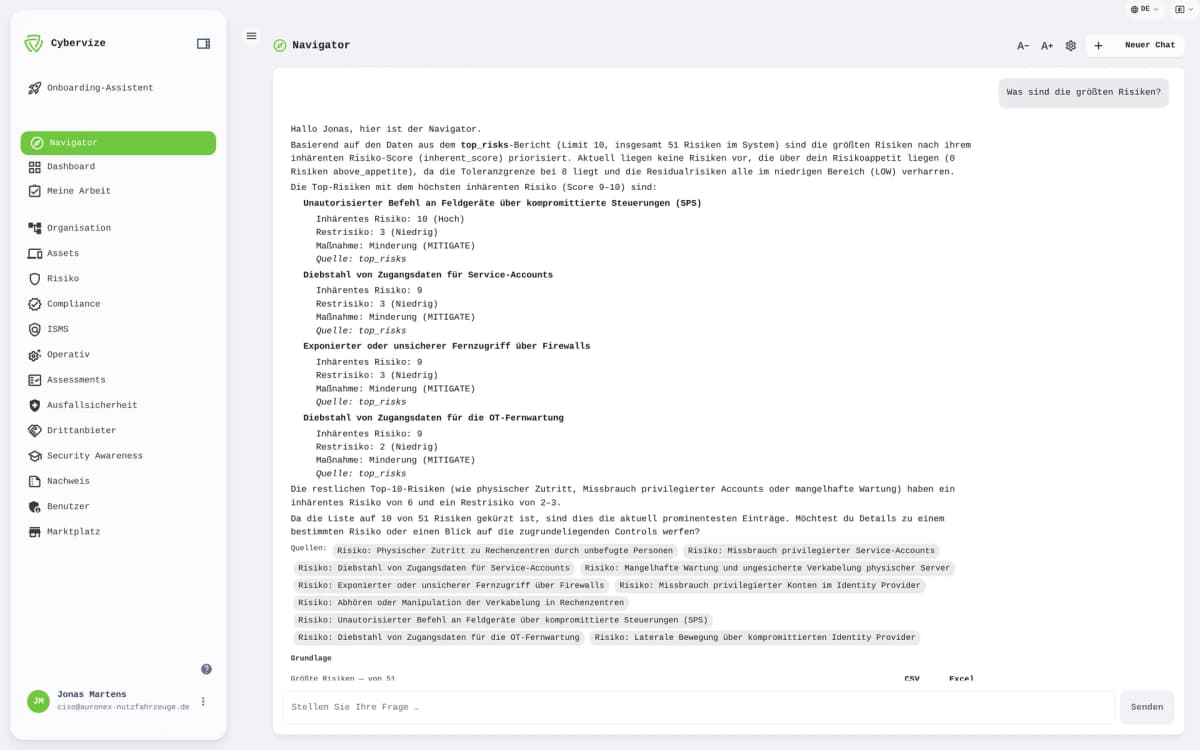
The four levers are not theory. In OdySecure, the security platform by Cybervize, they are product:
Model
Local LLM: the OdySecure Navigator runs by default on a language model operated in Germany.
Data flow
In Sovereign mode, no external outflow: no data passed to model providers, answers strictly limited to your own tenant.
Exit
Bring your own LLM: connect your own model; the Sovereign, BYOK and Managed operating modes can be chosen per tenant.
Proof
Audit log and AI system inventory: questions to the assistant are logged, AI systems managed following EU AI Act logic.
Standard vs. Controlled Exception
Standard (Default)
- Hosting in Germany/EU
- Services in Germany/EU
- Open Standards
- Free LLMs with governance
Controlled Exception
- Only defined data classes
- Data masking required
- DLP rules enforced
- Documented approval + review cycle
What is Digital Sovereignty?
Sovereignty is control over data flows, access, and decisions.
Standard is Germany or Europe.
When innovation requires a model outside Europe, a controlled exception applies with data classification, data masking, DLP, approval, and review.
Minimum Criteria for Digital Sovereignty
Hosting in Germany/EU
All systems and data are hosted in Germany or the EU.
Control over storage
Only you decide where your data resides and for how long.
Control over data flows
Transparent and documented data flows with no unexpected outflows.
Control over access
Who accesses your data? When? Why? Everything is traceable.
Services in Germany/EU
All software services and platforms run in Germany/EU.
Open Source
Preferred: open source code, transparent licenses, no black boxes.
Free LLMs
Large Language Models with open source code enable local deployment and auditability.
Exit option
You can always take your data with you, no vendor lock-in.
What we build from this in the vCISO mandate or in AI Security Governance
Data Classification + AI Prompt Rules
Clear structure for what is and isn't allowed.
AI Use Case Approval
Documented approvals for every application.
Exit Plan
How you can exit anytime, without data loss.
Escalation Matrix
Who gets notified when something goes wrong?
Audit Structure
How you can prove compliance anytime.
Frequently Asked Questions
No. Sovereignty means control, not isolation. The standard is Germany/EU, but controlled exceptions are explicitly allowed when innovation requires it. What matters: the exception is decided, limited, and auditable.
EU hosting is necessary but not sufficient. Equally important: control over access, transparent supply chains, exit options, and auditability in daily operations.
When the data class is defined, data masking occurs before model calls, DLP rules are in place, documented approval exists, and a review cycle is agreed upon.
Data masking includes redaction (irreversible removal of sensitive data) and tokenization (replacement with traceable placeholders). Both prevent sensitive information from reaching AI prompts or external systems.
Open (free) LLMs are models whose weights and terms of use are openly available. This can enable local deployment and greater control, e.g. over data privacy, logging, and testing. The degree of transparency depends on whether code and training artifacts are disclosed alongside the weights. Cybervize prefers such models where licensing and capability meet the requirements.
Sovereignty consultation: 15 minutes
We walk through your stack along the four levers: model, data flow, exit, evidence. Afterwards you know where your company stands.
Related Services
External CISO (vCISO)
Experienced C-level security leadership, 2 to 6 days a month, with the platform as the working tool.
Learn moreInterim CISO
Immediate security expertise for transition phases and critical projects.
Learn moreCybersecurity Assessment
Analysis of your IT security posture with an actionable roadmap.
Learn more